DFI LANParty Pro875 Mainboard (i875P)
|
Every company tries to attract attention with a better software suite,
integrated controllers or accessories. In this case the company has created
a dedicated niche for its product which will certainly catch the eye of
even those who are indifferent to this niche. So, meet LANParty boards!
According to DFI, there are two aspects why they named it LAN Party - a
PC transportation set (you can you can rent a computer club for LAN Party
gaming or use your PC as a multimedia station outside your home), and club-like
bright glow in UV rays.
The box contents:
-
Package: a big bright box which demonstrates how the PC-Transpo set could
be used; :)
-
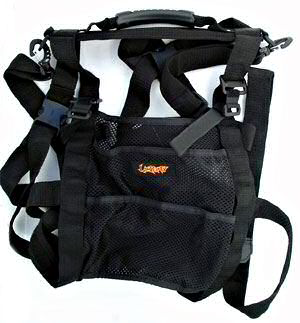
PC-Transpo: straps for PC transportation (the PC case is put into something
like a backpack which also has pockets for a keyboard, mouse etc.);

-
Documentation: User Guide in 5 languages, brief installation manual and
IDE RAID description in English;
-
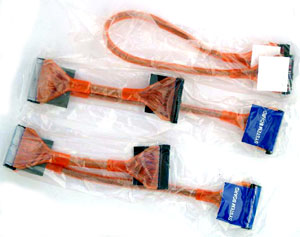
Cables: 2 Serial ATA (without power supply adapters), 2 ATA66/100/133 and
FDD - the latter connectors are shielded and covered with transparent orange
cambric;

-
Bracket with S/PDIF-In/Out (Coaxial);
-
Bracket with a Game port;
-
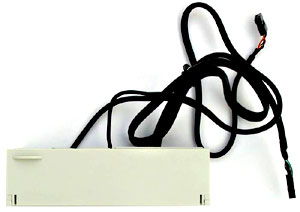
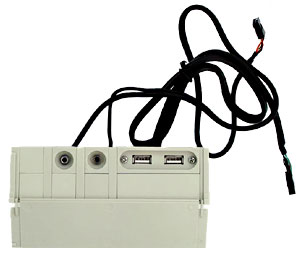
5" FrontX panel with Mic-In, Speaker-Out and 2 USB ports;

-
I/O shield;
-
Thermal grease;
-
2 diskettes with drivers for IDE and SATA RAID;
-
2 CDs with software including:
-
drivers;
-
user guide in PDF;
-
Adobe Acrobat Reader;
-
Award WinFlash 1.54;
-
RadarSync;
-
McAfee VirusScan Online;
-
Winbond Hardware Doctor;
-
InterVideo WinDVD;
-
InterVideo WinRip.
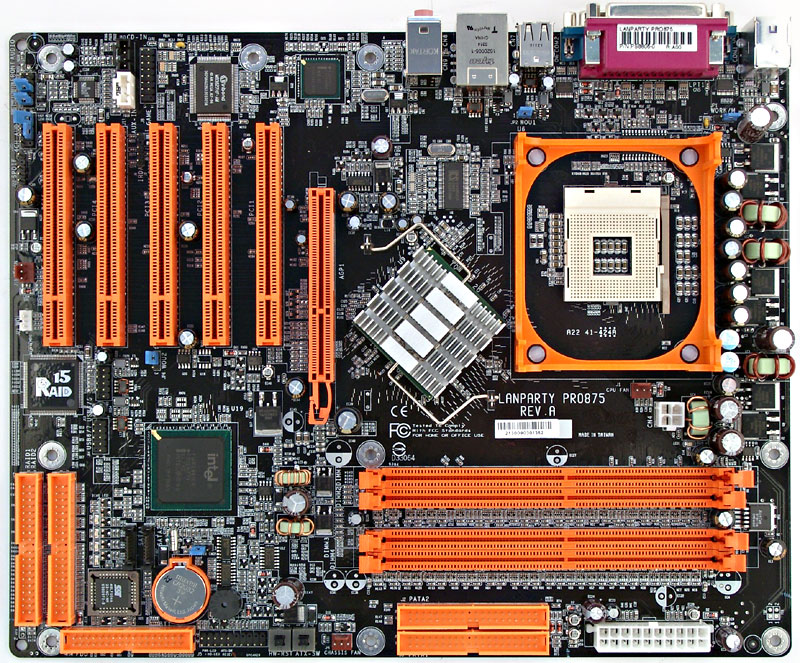
The layout is convenient but, still, there are some drawbacks: the IDE
RAID and FDD are behind the PCI slots, and audio-ins are in front of them.
It can be difficult to reach some jumpers when the board is already installed.
Jumpers description is provided on the PCB.
The 3-phase CPU voltage regulator includes 8 capacitors of 2200 uF and 4 of
1500 uF. There are also voltage regulators of the AGP bus (1 capacitor of 2200
uF and several less capacious ones) and of the memory (2 of 1500 uF).
Integrated controllers:
-
audio controller based on the C-Media CMI9739A AC'97 codec; 5.1 audio system
supported, front audio outputs and S/PDIF connectors provided
-
network controller based on the Intel 82547EI (Kenai II CSA) chip; 10/100/1000
Base-T (Gigabit Ethernet) supported;
-
IDE RAID controller based on the Highpoint HPT372N chip supporting RAID
0, 1, 0+1 and 1.5 (0+1 on two discs - half of each disc is taken for backup
information from the other) by the ATA133 protocol.
+5 V supplied in the StandBy mode is indicated with the red LED. The POST
controller monitors boot up process with 4 more LEDs. Also, there are power
and reset buttons onboard.
No wasted space for components that didn't get included in the final
design.
System monitoring is supported by Winbond W83627HF-AW chip. It controls:
-
processor, AGP bus voltages, +3.3, +5 and +-12 V, VBAT and +5 V Standby;
-
rotation speed of 3 fans;
-
temperatures of the processor (built-in sensor) and the board (built-in
sensor).
There are 2 connectors for regulated and 3 for unregulated connection of
fans.
Summary: memory slots - 4 DDR SDRAM; expansion slots - AGP/ 5
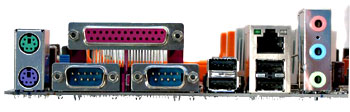
PCI; I/O ports - 2 COM/ LPT/ 2 PS/2/ 8 USB 2.0; dimensions - 305x245 mm.
Settings:
| jumpers and switches |
Jumper to clear CMOS |
|
| Jumpers for starting up computer from PS/2 devices |
|
| Jumpers for starting up computer from USB devices |
|
| BIOS based on Phoenix AwardBIOS 6.00PG |
Setup of memory timings |
+ |
CAS Latency, RAS Precharge, RAS to CAS Delay, Active to Precharge
Delay |
| Setup of memory frequency |
+ |
Auto, 266, 320, 400 MHz (at FSB 800 MHz) |
| Setup of AGP bus |
- |
|
| Setup of PCI bus |
- |
|
| AGP/PCI frequency setup |
+ |
AGP(PCIx2) = Auto, 66 MHz |
| PCI IRQ manual assignment |
+ |
|
| FSB frequency setup |
+ |
100-400 MHz in 1MHz steps |
| CPU clock ratio |
+ |
x8-x50 |
| Core voltage control |
+ |
from +0.05 to +0.35 V |
| Memory voltage control |
+ |
2.5-2.7 V in 0.1V steps |
| Chipset voltage control |
- |
|
| AGP bus voltage control |
+ |
1.5 and 1.6 V |
We used the BIOS of 16.05.03 as the latest available version.
In the express performance tests with the BIOS version indicated above
the board scores the following results:
| Test |
ABIT IC7-G |
ASUS P4C800 Deluxe |
DFI LANParty Pro875 |
| WinAce archiving (min:sec) |
11:45 |
10:06 |
11:50 |
| Return to Castle Wolfenstein, Fast@800x600x16 (fps) |
235 |
252 |
231 |
| Return to Castle Wolfenstein, High@1280x1024x32 (fps) |
181 |
189 |
180 |
It's still far from the leading ASUS P4C800 Deluxe (its performance was discussed
here), but in general, its scores are at
the level of most i875P based boards.
As a result, we have a high-quality board with good functionality and
a couple of unique image capabilities.
Test results of other i875P based boards (for comparison):
Write a comment below. No registration needed!
|
|
 |
|
|
 |
i3DSpeed, April 2012 Retested all graphics cards with NVIDIA Drivers 301.24 and AMD CATALYST 12.4.
Added test results of the reference and overclocked AMD Radeon HD 7850, NVIDIA GeForce GTX 690, NVIDIA GeForce GTX 680 SLI, AMD Radeon HD 7970 CrossFireX, AMD Radeon HD 7770/78
|
 |
i3DSpeed, March 2012 Retested all graphics cards with NVIDIA Drivers 295.73 and AMD CATALYST 12.3.
Added test results of the reference and overclocked AMD Radeon HD 7870 and NVIDIA GeForce GTX 680.
|
 |
i3DSpeed, February 2012 Retested all graphics cards with NVIDIA Drivers 295.52 and AMD CATALYST 12.1, added test results of AMD Radeon HD 7970/7950/7770/7750/6930.
|
 |
i3DSpeed, January 2012 Retested all graphics cards with NVIDIA Drivers 295.52 and AMD CATALYST 12.1, added AMD Radeon HD 7950 test results.
|
|