Mid-End Heatpipe Cooler Shootout
|
Part 3. Test Results (Intel), Summary Table
Test results on the Intel platform
In order to examine thermal efficiency of our LGA775 coolers under review, we put the same methods into service as in testing cooling systems for Socket 478 as well as AMD Socket 754/939/AM2. The primary data used for the consequent calculation of thermal resistance are temperature readings of the thermal diode built into a processor. Only the thermal source (Pentium 4 550), the base platform (ASUS P5AD2-E Premium motherboard), and a set of applications are different.
We also measure temperatures of the inductance coils in the CPU voltage regulator. To be specific, we measure temperatures of the PL24, PL25 and PL26 inductance coils near the socket. This provides additional data that helps us evaluate the cooling efficiency. CPU voltage is also raised to 1.525 V in order to generate more heat in the testbed. The resulting heat power is 150 W. Testbed configuration:
- Motherboard: ASUS P5AD2-E Premium rev. 1.05
- Processor: Intel Pentium 4 550 (3.4 GHz Prescott, HT Technology)
- OS: Microsoft Windows XP
We use the S&M utility to create maximum thermal load on the processor and Speedfan to monitor temperatures. The Thermal Monitor is disabled in all the tests.
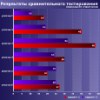
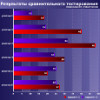
Diagram 1. Temperature readings (Intel)
Notes
Each cooler is tested with Stars 420 thermal grease
Diagram 2. Thermal resistance (Intel)
Note
Thermal resistance θja is defined as the relation
θja = (Tj—Ta)/Ph, where Tj is the temperature of a CPU core, Ta is the environment temperature (it's 25°C in this case), Ph is the thermal capacity of a processor (in this case it's 150 Watts).
Diagram 3. Temperature readings (temperature of near-socket components)
Finally, at the end of this article we publish the noise measurement results (the procedure is described in the article Noise characteristics of coolers and the noise measurement method) as well as the efficiency/noise rating of the coolers.
Diagram 4. Noise characteristics
Note: Background noise level 18 dBA
Diagram 5. Efficiency/noise ratio
Note
The efficiency/noise ratio (ENR) is calculated as:
ENR = DM*(Rt/P¢C)/(NL/Rn), where
Rt—reference temperature (the reference thermal resistance θja of the cooling system - 0.25°C/W), TC—the core temperature with the operating cooling system, Rn—reference noise (the reference noise level is 20 dBA), NL—noise level, generated by the cooling system, DM—denominate multiplier (10).
Summary table
Table 1. Summary data on the coolers we tested
| Cooler |
TR,
C/Watt2 |
Noise, dBA |
Weight, g1 |
Dimensions, WxLxH, mm |
Retention module |
Price, USD3 |
Arctic Cooling
Freezer 7 Pro |
0.28*
|
37*
|
530
|
107x97x127
|
LGA775
|
25
|
| ASUS Triton 70 |
0.33*
|
33*
|
435
|
90x78x125
|
LGA775
Socket 754/939/AM2
|
32
|
Cooler Master
Hyper TX2 |
0.31*
|
36*
|
480
|
107x118x138
|
LGA775
Socket 754/939/AM2
|
30
|
Cooler Master
Vortex 752 |
0.39*
|
38*
|
360
|
107x107x70
|
LGA775
Socket 754/939/AM2
|
26
|
GlacialTech
Igloo 5610 Silent |
0.35
|
32
|
400
|
99x66x110
|
LGA775
|
16
|
GlacialTech
Igloo 5610 PWM |
0.31*
|
41*
|
400
|
99x66x110
|
LGA775
|
16
|
GlacialTech
Igloo 5710 Silent |
0.33
|
31
|
485
|
93x102x135
|
LGA775
Socket 754/939/AM2
|
30
|
GlacialTech
Igloo 5710 PWM |
0.28*
|
40*
|
485
|
93x102x135
|
LGA775
Socket 754/939/AM2
|
30
|
GlacialTech
Igloo 5750 Silent |
0.29
|
30
|
515
|
96x120x120
|
LGA775
Socket 754/939/AM2
|
40
|
GlacialTech
Igloo 5750 PWM |
0.25*
|
40*
|
515
|
96x120x120
|
LGA775
Socket 754/939/AM2
|
40
|
Scythe
Samurai Z Rev.B |
0.37
|
36
|
375
|
128x85x98
|
LGA775
Socket 754/939/AM2
Socket 478
|
30
|
| Scythe Katana 2 |
0.34
|
32
|
550
|
105x82x150
|
LGA775
Socket 754/939/AM2
Socket 478
|
35
|
| Scythe Kama Cross |
0.32
|
32
|
560
|
140x120x132
|
LGA775
Socket 754/939/AM2
Socket 478
|
40
|
| Scythe Mine Rev.B |
0.27
|
34
|
580
|
109x105x150
|
LGA775
Socket 754/939/AM2
Socket 478
|
38
|
Thermaltake
Sonic Tower Rev.2 |
0.33
|
32
|
860
|
112x140x150
|
LGA775
Socket 754/939/AM2
|
38
|
| Thermaltake TMG
i2 |
0.37*
|
37*
|
385
|
102x115x103
|
LGA775
|
25
|
Titan
TTC-NK45TZ Bomber |
0.33*
|
36*
|
505
|
110x79x150
|
LGA775
Socket 754/939/AM2
|
17
|
| 1Full weight, including a retention
module |
| 2TR—thermal resistance |
| 3Average retail prices (Moscow)
or recommended prices (new products) for December 11, 2007. |
| *This parameter corresponds to
maximum fan speed |
There seems to be no need in any comments here. Let's proceed to test results on the AMD platform!
Write a comment below. No registration needed!
|
|
 |
|
|
|