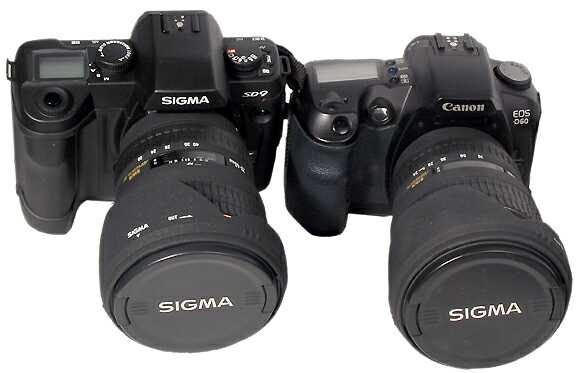
The launch of the Sigma SD9 camera with the Foveon matrix was the focus
of attention last year. The announcement of the matrix was followed by
multiple articles trying to analyze its prospects.
I have nothing new to say about its ergonomics and management. For those who
use photography in their work, i.e. reporters or photo artists, there is no difference
between the matrices: CCD of the Nikon D100, CMOS of the Canon EOS D60 or Foveon
of the Sigma D9. These cameras are of absolutely the same class, and the determining
factors will be removable optics, layout of buttons etc. Just note that the Sigma
is rather a prototype today than a real working horse. The difference between
the camera with the Foveon matrix and cameras with mosaic filters is significant
for those who register images for further analyses. When the camera is used as
a measurement tool, it's important to understand what is an observed value and
what is a result of interpolation. The attempts to give up mosaic filters took
place before the Foveon matrix as well. For example, the Minolta RD175 camera
used three matrices with single color filters in front of each. Such approach
is popular with video cameras as well. But the necessity to divide a light flux
so that it gets onto three independent matrices brings about the requirement of
precise overlapping of three images, which is not an easy problem for 1Mp cameras.
The principle difference between the reviewed cameras is how the visible spectrum
is divided into frequency ranges. The Canon uses zone filters located in front
of every sensor. The Foveon matrix
uses the fact that photons of different wavelengths are absorbed in silicon at
different levels of depth. The expected spectral sensitivity of the Foveon matrix
is given in the above mentioned review. Let's look at the spectrum of a halogen
incandescent lamp KGM KÃM 250 obtained with a gitter. The cameras (in turn) were
attached to the tripod, an image was registered in the RAW format and then converted
into TIFF and transferred to Photoshop. The white balance was set for daylight
because we wanted to register exactly the spectrum of the incandescent lamp, not
to shoot an object it illuminated.

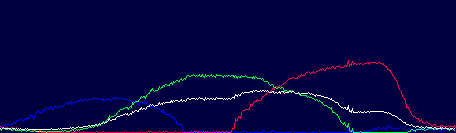
Above - Sigma SD9. F:5.6; 1/2 s; ISO 100;
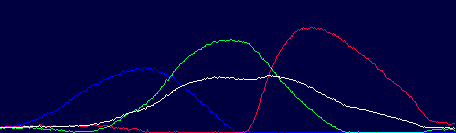
Below - Canon EOS D60. F:5.6; 1/2 s; ISO 100;
As you can see, the spectrums are quite different. While in the Canon
camera the spectral sensitivity is defined by zone filters, and the effect
of the filter located in front of the matrix which doesn't let IR radiation
pass through is almost unnoticeable, for the Sigma the restrictions in
the long-wave part are on account of this additional filter. In the range
of 530-550 nm the Foveon matrix registers a signal only in the green channel,
and the signal's value doesn't depend on the wavelength, while the Canon
has a very narrow band where signals in the blue and red channels are lacking
at all. We can't say which camera shows the original spectrum more precisely,
there is inaccuracy in both cases. But the error will be different for
different wavelengths. For example, the Sigma poorly discerns the difference
in the tints of the green color at around 550 nm; but it's able to register
much more minor differences at around 500 nm in contrast to the Canon.
If we shot a laser beam of 500 nm, the Sigma's camera would fix it as blue
and green, while the Canon's solution - as almost pure blue. The wavelengths
I indicated are approximate and can differ by 10-15 nm. The yellow part
of the spectrum will also be delivered differently by these two models.
In the red range the Canon's sensitivity gradually reduces as the wavelength
gets shorter, while it hardly changes in the whole red range in case of
the Sigma's solution, and as I mentioned before, it is sharply cut off
with an external filter. If we take it off (which is possible in the Sigma
because it's located in front of the mirror and easy to reach) the camera
could shoot in the near IR range.
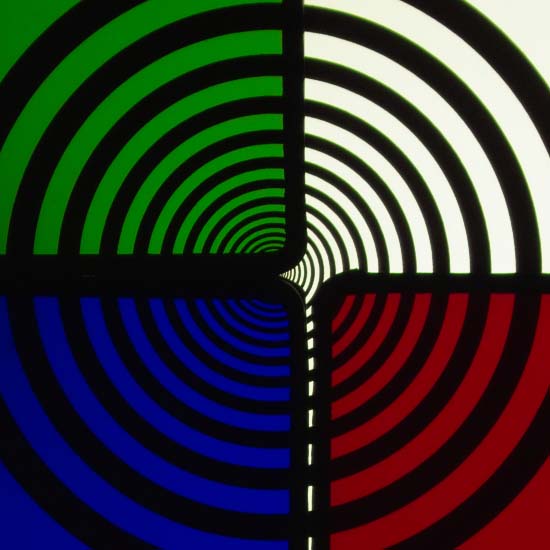
Now we are to shoot the resolution chart through zone filters lying
on the light table which uses a luminescent lamp of the conditional color
temperature equal to 8000K.

Canon EOS D60. F:5.6; 1/8 s; ISO 100; White Balance - Cloudy
Sigma SD9. F:5.6; 1/8 s; ISO 100; White Balance - Overcast
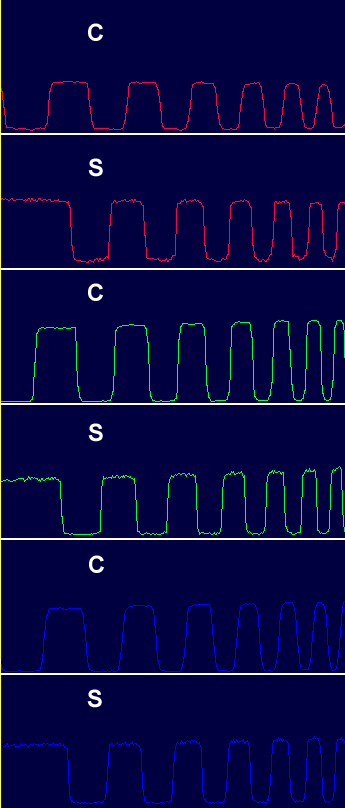
When shooting with the Sigma the signal amplitude graphs remain square
irrespective of the zone filter's color even in case of thin grooves, while
with the Canon the squares turn into a sinusoid quite quickly. The latter
is able to register brightness different from zero of only 1.5 million
pixels behind the blue or red filter, while the Sigma always registers
3 million. The image is similar for the green grooves, but the number of
elements sensitive to this spectral region is equal, - 3 million. That
is why 6 million sensors behind the mosaic filters can be an advantage
only with a black-and-white resolution chart of the absolute contrast.
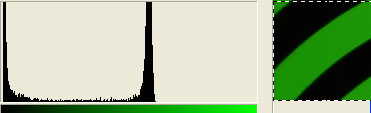
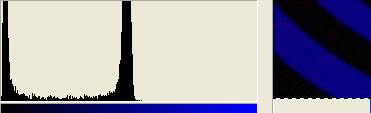
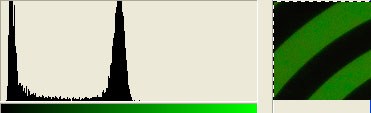
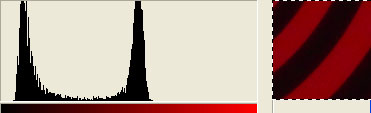
Now let's see how a noise level depends on sensitivity using the same
shots. Here you can see histograms of brightness of the pixels on the image
of 100x100 pixels which shows several black and white grooves behind the
zone filter. At ISO 100 the width of the peaks corresponding to the black
pixels and white ones is almost the same. The difference in the width for
the image made with the red zone filter is probably caused by the fact
that the filtering areas of the Canon do not overlap, which makes the signal
weaker in the red range.
At 400 ISO (the highest ISO value for the Sigma) the histograms of the
Canon's model look almost the same, while noise of the Sigma's solution
has reached a significant level when it's not recommended to shoot.
Canon EOS D60. F:5.6; 1/8 s; ISO 100; White Balance - Cloudy
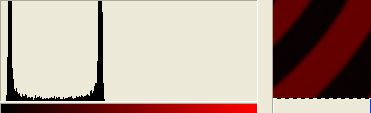
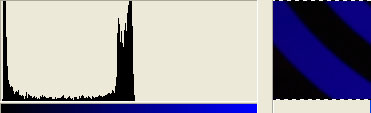
Sigma SD9. F:5.6; 1/8 s; ISO 100; White Balance - Overcast
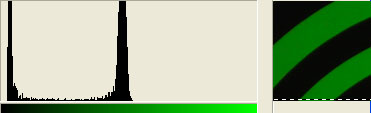
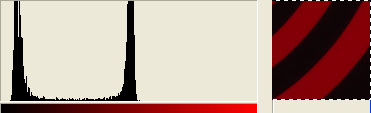
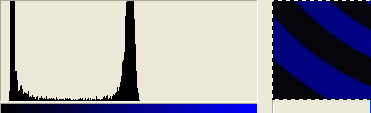
Canon EOS D60. F:5.6; 1/45 s; ISO 400; White Balance - Cloudy


Sigma SD9. F:5.6; 1/30 s; ISO 400; White Balance - Overcast

Finally, let's compare the resolution charts of the absolute contrast.
In the center is a shot made with the Canon's camera, on the left you can
see the original image made with the Sigma's camera, and on the right we
have a shot made with the Sigma, with the size brought in the Photoshop
to the Canon's shot size. The shots are taken in RAW, converted into TIFF,
combined in the Photoshop into one image and then recorded in JPEG. As
you can see, the Sigma has a higher groove/pixel resolution; the resolution
of the shots brought to the single size is almost equal, but if the image
remains black-and-white for the Sigma, the Canon allows for a color moire
for thin grooves, because of the different frequency of the elements sensitive
to the different spectral distribution.
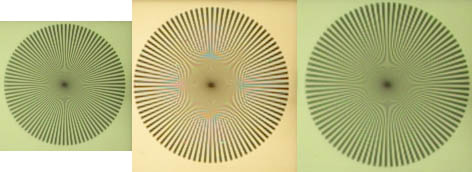
If we convert the image into gray, then turn the chart made with the
Canon by 45 degrees and match the images, we will get almost identical
moire pattern and resolution for these cameras.

The image is enlarged twice.
Conclusion
The Sigma hardly yields to the Canon's camera. The arithmetic is right,
and the average between 3 million pixels of the image and 9 million sensors
gives the same result as 6 million registered pixels and 6 million sensors.
The Sigma's model has specific spectral characteristics which can be useful
in scientific researches. And it has a better resolution than cameras with
mosaic filters when shooting color grooves on the white background or black
grooves on the color background. The line of the Sigma's
lenses is rather wide and can satisfy both reporters and photo artists,
but the situation with optical systems for scientific researches and adapters
for scientific equipment is not so good, and you will probably have to
make them yourselves. It's possible from the technical standpoint, but
taking into account that the film cameras of Sigma were never positioned
for this sphere, and third parties never produced adapters for the Sigma's
bayonet, it's questionable whether Sigma will be able to get its share
on the market of scientific equipment, or someone else would make a camera
with the Foveon matrix for the M42 lens.
Write a comment below. No registration needed!